Sunday, February 26, 2012

City Lights


Spotted in the wild at City Lights in San Francisco. Keeping some good company too. The all-things-digital section there is named "Topographies," which I rather like.

Mechanisms: The Floppy Edition


The paperback printing of Mechanisms (ISBN 026251740X)has been out for a couple of months now and appears to be doing nicely. A couple of minor erratum were corrected and the cover design is slightly reworked, but otherwise it is the same as the cloth edition. Thank you MIT Press!

Friday, July 15, 2011

Paperback Coming!

I have received word from the MIT Press that Mechanisms will be available in a new paperback printing in early 2012. Several errata will be corrected, but the text will otherwise be unchanged. I have no info about pricing, but I assume it will be comparable to other MITP paperback titles.

Thursday, January 27, 2011

Spotted in the Wild


Or actually, in its native habitat. Brett Bobley snapped this pic of Mechanisms on the shelf at the MIT Press Bookstore in Cambridge, Mass. In good company too. Thanks Brett!

Monday, January 10, 2011

Kindle Edition


Mechanisms is now out in a Kindle edition.

Saturday, December 18, 2010

CLIR Digital Forensics Report Out

Forensics ReportI'm very happy to announce the availability of Digital Forensics and Born-Digital Content in Cultural Heritage Collections, a new CLIR report emerging from the Mellon-sponsored workshop on the same topic held last spring here at the University of Maryland. The report (written by myself, Richard Ovenden, and Gabriela Redwine, with research assistance from Rachel Donahue) introduces the field of digital forensics in the cultural heritage sector and explores some points of convergence between the interests of those charged with collecting and maintaining born-digital cultural heritage materials and those charged with collecting and maintaining legal evidence.

Digital Forensics and Born-Digital Content in Cultural Heritage Collections is available electronically at http://www.clir.org/pubs/abstract/pub149abst.html. Print copies will be available in January for ordering through CLIR's Web site, for $25 per copy plus shipping and handling.

Sunday, August 8, 2010

2nd DHQ Review

Mechanisms is extremely fortunate to be the recipient of a 2nd review in Digital Humanities Quarterly. After Johanna Drucker called the book "an exemplary demonstration of scholarly method for the emerging field of digital media studies" in issue 3.2, Manuel Portela now reviews Mechanisms alongside of Kate Hayles's Electronic Literature in a review essay entitled "The Machine in the Text, and the Text in the Machine."

Portela is interested throughout in the overlapping network topologies of digital technologies and online reading environments on the one hand, and the material histories of writing, computing, and inscription that attend textual production across various media. Here is how he concludes:
Hayles’s and Kirschenbaum’s new books offer critically rigorous, intellectually provocative, and highly productive perspectives on new media literary objects. Their technical, sociotextual, and interpretive analyses raise our critical awareness of the specifics of digital materiality and electronic literature to a new theoretical and analytical level. Hayles’s readings of electronic works are exemplary in the way they relate electronic performability to interpretability. Using tropes such as "recursive dynamics," "intelligent machines" and "emergent cognition," she has tried to capture the embodied nature of technology and the distributed nature of subjectivity in human-computer interactions. Kirshenbaum’s approach, in turn, opens up electronic objects to textual criticism, extending the genetic and social text approach of the last two decades to digitally born artifacts. He offers a critically nuanced and technically rigorous description of the multiple layers of formal and forensic materiality, and stresses their interdependence. Taken together, the "electronic" in Electronic Literature and the "mechanism" in Mechanisms clearly resonate in the way they both attempt to link the deep level of machine code to the formal level of textual and metatextual code to the social level of cultural code. The machine in the text and the text in the machine — quintessential expressions of our present postmodern technotextual condition — are now more fully conceptualized in their technical, aesthetic, and social materialities.

Saturday, April 24, 2010

Hyperrhiz Review

Dene Grigar has a generous and very well done review of Mechanisms out in Hyperrhiz, as part of a special issue on New Media Subversions:
Stepping back, we can see that Mechanisms is an important book, but not only for the obvious reasons. Yes, it offers the conclusive evidence, the smoking gun (guns since there are three of them), that we have need for talking about the materiality of digital texts. Yes, the book contributes to the growing body of scholarship on platform studies and introduces the study of forensics to digital media. But most importantly, it offers the philosophical and methodological framework needed to grow the field, for it helps to move the humanities toward a renaissance of close reading and textual study, revitalizing it and providing it a strong central practice. Mechanisms is a must read for all of us working in digital media who wonder where it is headed and where it needs to go.

Sunday, March 7, 2010

Want


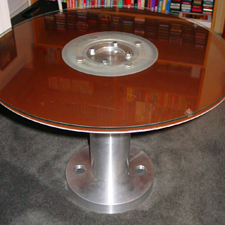
This amazing hard disk coffee table, fashioned from a 26-inch CDC platter.

Sunday, February 7, 2010

netpoetic

Eliza Deac offers a concise but very well articulated review of Mechanisms on the group netpoetic blog.

Wednesday, January 27, 2010

Infodecodata

More hard drive-based art: Infodecodata has issued an open call for participants to generate treemap images of their hard drives using their Sequoia visualization software and upload them to an online exhibition gallery.

There is a clear lineage here that includes Carlo Zanni's You Are Your C (see below), Mary Flanagan's Phage and Cory Arcangel's Data Diaries, all discussed in Mechanisms.

Sunday, January 3, 2010

Endless Nameless

Somewhere in Mechanisms I suggest that the hard drive has been under-utilized as a platform (in its own right) for digital art. I mention a couple of pieces like "Your Are Your C" by Carlo Zanni, and speculate that we will see more.

From Danny Snelson comes word of "Endless Nameless," a collaborative project that involves stocking used hard drives with data assemblages and selling them, iTunes-like, for .99/GB:
Endless Nameless presents a double articulation of popular data trafficking along with the material histories of our digitally dislocated artifacts. Cataloging this 'nude media' by original source, the book loops these distribution circuits in a nostalgic allegory of publication: celebrating the publishers while disseminating huge amounts of unsanctioned information.

I like it. I just can't afford it.

Thursday, December 3, 2009

Mechanisms Wins MLA First Book Prize

I am simply floored to be announcing that Mechanisms has won the MLA's sixteenth annual Prize for a First Book. The press release and citation is here. The award will be conferred at the convention in Philadelphia at the end of the month.

Two Reviews and a Response at RCCS

The Resource Center for Cyberculture Studies has published two new, very enthusiastic, reviews of Mechanisms: the first is by Viola Lasmana and the second is by Jentery Sayers. In addition, since it has been out for two years this December, I took the opportunity to write a response and offer some reflections on the book's reception and implications.

I feel especially fortunate to have Mechanisms joining the last set of reviews to be published at RCCS, which was founded over a decade ago by David Silver when he was still a graduate student in American Studies here at the University of Maryland. David is now retiring the site to move on to other projects, but RCCS was one of the places where I had long been looking forward to earning a review, and while it's a relief to have them come back so positive it's also a sadness to see the site come to the end of its work.

Friday, September 11, 2009

British PM Apologizes to Alan Turing

As has been widely reported, the British government today issued a state apology to Alan Turing, prosecuted (and ultimately driven to suicide) for his homosexuality.

Turing, of course, is a transformational figure not only in technology circles but Western intellectual history. In addition to his wartime role as a code-breaker, he made fundamental contributions to both computer science and artificial intelligence. In Mechanisms, I evoke Turing's uncanny ability to "read" the dance of lights in a cathode ray tube, then being used primarily as a storage rather than a display device. To quote Turing's biographer Alan Hodges, "He insisted that what one saw as spots on the tube had to correspond digit by digit to the program that had been written out" (399). Here's what I go on to say:
The popular dramatization of forensics as criminalistics . . . is, I would argue, a mere caricature of the forensic imagination, which is finally—and profoundly—humanistic and generative. In a famous analysis, Carlo Ginzburg links the art historian Giovanni Morelli, who focused on the seemingly incidental details of portraiture (ear lobes and such) to ascertain whether the hand of the master was present, to Sherlock Holmes and Freud (who had himself read Morelli) and finds shared among them, “an attitude oriented towards the analysis of specific cases which could be reconstructed only through traces, symptoms, and clues” (104). Ginzburg then adds a fourth and more primal figure to the tableau, a hunter kneeling on the trail to study the scat or track of his prey. This, according to Ginzburg, is our first reader of signs. Superimposed on the posture of that hunter I also see Alan Turing, leaning, straining, to “peep” the glowing spots and dashes in the Williams tube, marks inscrutable to most but as revealing to Turing as day-old prints on the forest floor. And superimposed over Turing, I would argue, is the familiar posture of today’s computer user—shoulders hunched, head thrust forward, peering into the depths of the screen . . . (256-7)

Saturday, July 11, 2009

Computer Forensics and Born-Digital Content in Cultural Heritage Collections

Funding for a new project which I'm very excited about as it gives me a chance to apply some of the ideas in Mechanisms in real-world contexts. Here's the official announcement:

The Maryland Institute for Technology in the Humanities (MITH) at the University of Maryland is pleased to announce the receipt of an $81,000 award from the Scholarly Communications program of the Andrew W. Mellon Foundation. The award will support research for and the writing of a report entitled Computer Forensics and Born-Digital Content in Cultural Heritage Collections, to be published in fall 2010 by the Council on Library and Information Resources (CLIR); the award will also fund a symposium on the same topic at the University of Maryland in May 2010, at which experts from the cultural heritage sector and computer and information science, as well as practitioners in government, industry, and defense will convene to comment on the report and explore shared interests and practices.

Maryland's work on the report and symposium will be lead by principal investigator Matthew Kirschenbaum (Associate Director of MITH and Associate Professor of English); he will be joined by co-authors Richard Ovenden (Keeper of Special Collections and Associate Director, Bodleian Library, Oxford) and Gabriela Redwine, an archivist and electronic records specialist at the Harry Ransom Center at The University of Texas at Austin.

MITH's director Neil Fraistat comments, "Matt Kirschenbaum's leadership in bibliography, digital forensics, and digital preservation has helped position MITH at the forefront of crucial new work that is reconfiguring archival studies and practices. One of two recent grants from the Mellon Foundation on which MITH will be working in the coming year, Computer Forensics and Born-Digital Content in Cultural Heritage Collections allows us to continue fruitful partnerships with the Bodleian Library and the Ransom Center and promises to be a major leap forward for the field."

Friday, July 3, 2009

DeLong Book History Prize

I'm thrilled and humbled to announce that Mechanisms has won the DeLong Book History Prize from the Society for the History of Authorship, Reading, and Publishing (SHARP). The prize is conferred annually for the "best book on any aspect of the creation, dissemination, or uses of script or print published in the previous year." It was announced last week in Toronto at the organizaton's annual conference.

When I wrote Mechanisms I knew, by virtue of the imprimatur of the MIT Press, that the book would find its audiences in new media studies. Equally important to me but much less certain was whether it would attract readers in fields like textual scholarship and the history of the book, which I considered the main precedents for my particular approach to the born-digital. The fact that Mechanisms has succeeded so well in doing this is immensely gratifying (as also evidenced by its winning the Finneran Prize), and I'm equally delighted that SHARP's sense of "book history" so obviously includes artifacts like hard drives and diskettes.

I have many friends in the SHARP community, though somehow I have never made it to their annual conference. Next year it is in Helsinki which might be a stretch but I will certainly be putting in a proposal for the 2011 conference in DC. Thank you again to SHARP!

Beach Reading

Peter Lunenfeld is including Mechanisms in his summer 2009 beach bag as a "key monograph" for the digital humanities, as reported on Roy Christoper's Summer Reading List. Thanks Peter!

Saturday, June 13, 2009

Heavy Data

Hands down the best thing on the materiality of digital infrastructure I've read since Neil Stephenson's magisterial "Mother Earth Mother Board": Tom Vanderbilt's "Data Overload" looks at the architecture of data centers (and the geography of "the cloud") for the New York Times Magazine.
Much of the daily material of our lives is now dematerialized and outsourced to a far-flung, unseen network. The stack of letters becomes the e-mail database on the computer, which gives way to Hotmail or Gmail. The clipping sent to a friend becomes the attached PDF file, which becomes a set of shared bookmarks, hosted offsite. The photos in a box are replaced by JPEGs on a hard drive, then a hosted sharing service like Snapfish. The tilting CD tower gives way to the MP3-laden hard drive which itself yields to a service like Pandora, music that is always “there,” waiting to be heard.

But where is “there,” and what does it look like?

In the spirit of Mechanisms' "following the bits all the way to the metal," Vanderbilt goes and finds out.

Thursday, May 28, 2009

Flash Drives From Flight 1549

Flash drives salvaged from baggage left behind from US Air flight 1549's emergency landing in the Hudson have been returned to passengers in good working order.